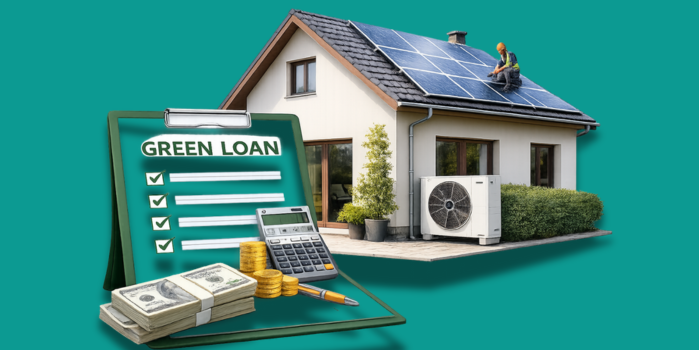
Green loans have become popular, of late. They are similar to any other loan, with only the difference that they are aimed at funding environmentally friendly projects like the installation of solar panels. Having witnessed the unwelcoming effects of greenhouse gases, the government is now insisting on green development.
While a net-zero lifestyle is elusive at the moment, the government is emphasising adopting sustainable living, and in order to make it a reality, it is funding the cost of shifting from unsustainable practices to an eco-friendly lifestyle.
The purpose of providing green loans is to encourage adoption of renewable energy sources so as to reduce carbon footprints. Green loans can be used for all kinds of eco-friendly improvements, including the installation of solar panels. It is true that a green loan can be used to pay for solar panels or heat pumps.
When is a loan called a green loan?
A loan must meet the green loan principles in order to be called a green loan. Here are the four components that must be reflected in a green loan:
| Components | Explanation |
| Use of proceeds | The green project for which you are looking to borrow must provide environmental benefits. A borrower will have to assess and measure those benefits and report them to a lender during the application process. |
| Process for project evaluation | In order to qualify for a green loan, you will have to clearly explain how you will be managing environmental projects. Additionally, you need to provide details for which project you want to receive proceeds. |
| Reporting | This recommends informing of qualitative performance indicators that measure how greenhouse gas emissions are reduced. |
| Management of proceeds | The amount will be credited to a dedicated bank account, and it is the responsibility of the borrower to be transparent about money utilisation. |
What are the types of green lending?
There are four types of green loans:
Bilateral green loans
Bilateral green loans are those that include only two parties: a lender and a borrower. They are ideal for small green improvements. For instance, green loans for solar panels are an example of bilateral green loans. However, when you need a green mortgage, you will have to consider applying for syndicated green loans.
Syndicated green loans
These green loans involve multiple lenders. They pool together their money to invest in high-risk projects. They are generally large projects, for instance, the construction of an eco-friendly building. Green infrastructure involves large projects. Since they cost a lot of money, loans could also be slightly expensive.
A revolving line of credit
A flexible line of credit is aimed at those people who need smaller green improvements. It works as an ordinary line of credit in which you will have a draw period and a repayment period. You can withdraw funds as per your requirements any time, provided the money is invested in a green project.
Interest will be accrued only on the withdrawn balance. There is no fixed timeframe to repay the balance as long as your draw period remains active. You can pay as per your own comfort.
Green project finance
Green project financing includes funding large sustainable projects. The financing aims to serve as a way to improve energy efficiency.
Why green loans are appealing?
Here are the benefits of green loans:
Lower interest rates
Green loans often charge lower interest rates. Even though your credit rating is less than perfect, you will be in a position to borrow money at competitive interest rates. Green loans charge lower interest rates than personal loans. One of the reasons why these loans charge high interest rates is that people are encouraged to invest in green projects.
Flexible repayments
As compared to other loans, you will be offered flexible repayment plans. According to that, you will be paying down the debt based on your financial condition.
They are eligible for subsidies
The best thing about these loans is that you can apply for government subsidies to reduce the upfront cost. This will help reduce the loan-to-value and thereby the interest too.
Ideal situations to apply for a green loan
Here are the ideal situations to apply for a green loan:
- These loans are ideal for solar panel installation, or for investing in a house or project that reduces carbon emissions.
- If you want to purchase an electric car, you will be able to qualify for green loans very easily. Above all, you can qualify for competitive interest rates.
- If you want to take up any renovation projects aimed at improving home energy efficiency through thermal insulation and energy-efficient window installation.
- These loans are also ideal for businesses. If you are running a company and you want to take up a project of solar panel installation, for example, to reduce its energy costs.
- You are to take up a construction project targeting a sustainable environment. Sustainable building projects often rely on green loans.
- If you need to strengthen a recycling and waste management system. Since they are aimed at reducing the impact of greenhouse gases on the environment, it becomes much easier to qualify for green loans.
How to apply for a green loan
Applying for a green loan should not be challenging. The whole process is simple.
- First off, you need to ensure that you meet the approval criteria. The approval for green loans is not a cinch. While the basic criteria remain the same, you need to make certain that your project meets the “green” standards.
- Afterwards, you need to choose the right lender. Both banks and direct lenders provide these loans. Compare interest rates and then decide which one suits your needs.
- Apply for government subsidies to minimise the total cost of the loan.
- Submit documents. Once your loan application process is completed, money will be sent to a dedicated account.
To wrap up
You can take out green loans for solar panel installations. The usage of these loans is not limited to that as they are suitable for all green projects.